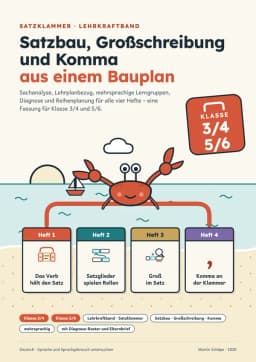
Series · German · grades 3–6
Klara and the sentence bracket
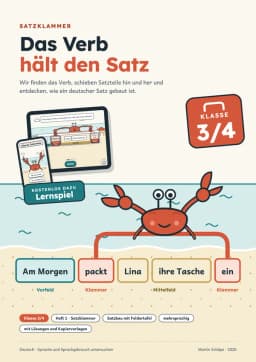
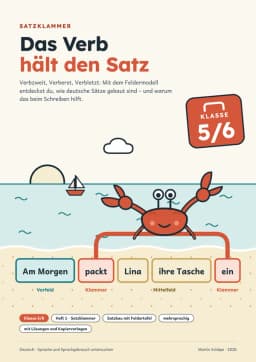
With her two claws, Klara the little crab holds on to the verb: the verb on the left, its second part on the right – if it has one. Starting from this image, children learn how a German sentence is built – in a learning game on screen and in four workbooks on paper. The game and the material are in German.
The series includes
- Learning game “Klaras Satzreise”
- Four workbooks, each for grades 3–4 and 5–6
- Field chart, cards and the project day “Satzwerkstatt”
- Teacher’s volume

Learning game · grades 3–4
Klaras Satzreise (Klara’s sentence journey)
A game right in the browser, no sign-up. Klara guides children through three stations at the beach. The game is in German.
Three stations
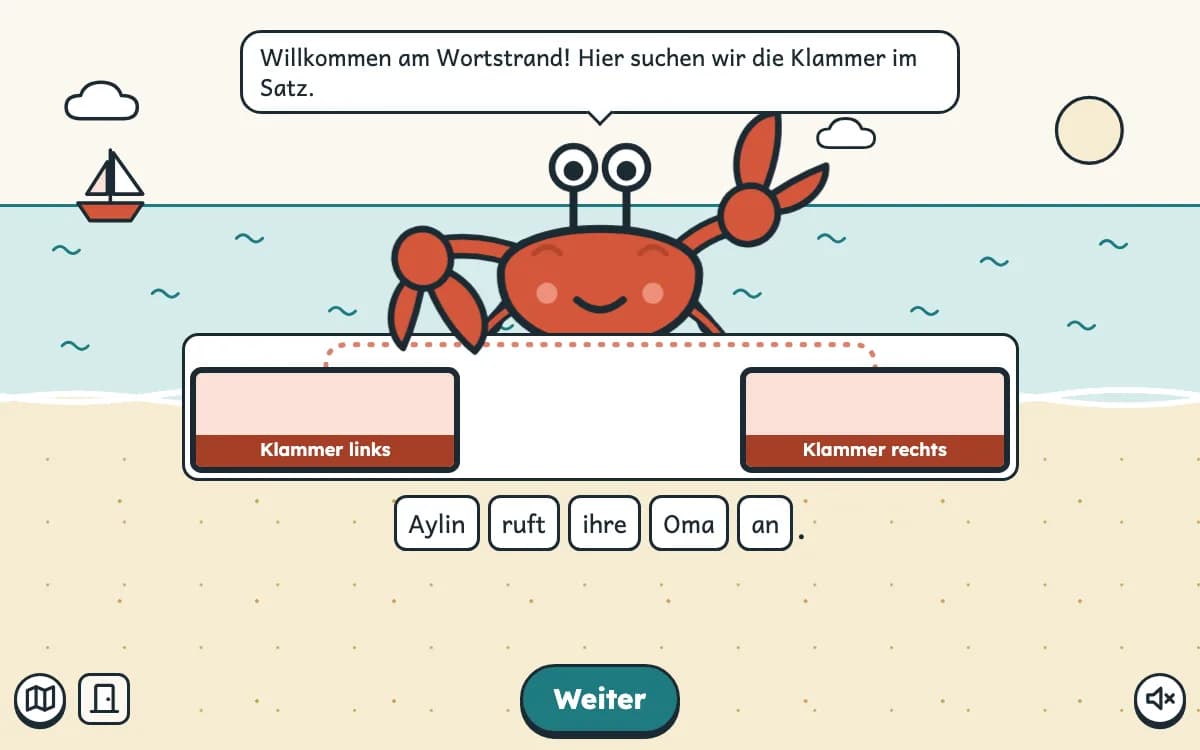
- Word beachFind the bracket: which word does Klara hold on the left, which on the right – or does the right claw stay empty?
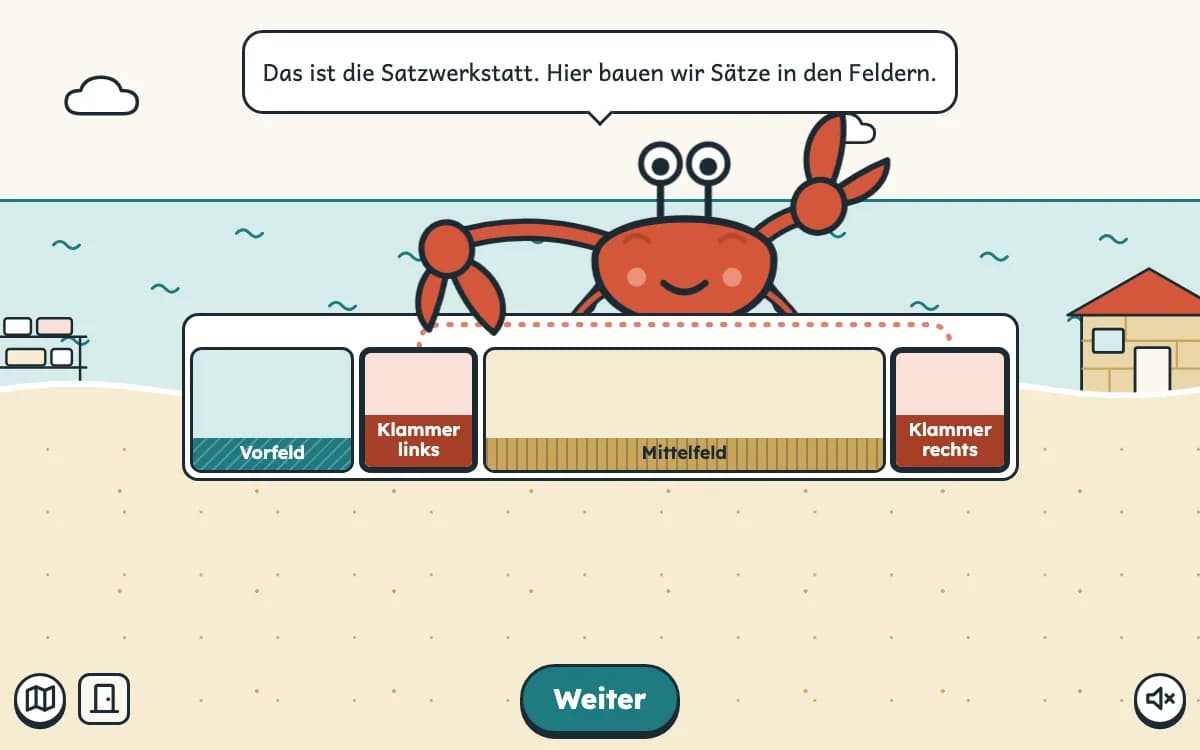
- Sentence workshopBuild sentences: place sentence parts in the prefield, left bracket, middle field and right bracket.
- Wave bayMove parts around: one sentence part moves to the front, the verb parts stay in the bracket.
How the game is built
- No time pressure, no points, no error sound
- Klara gives hints and checks; only after the third wrong try does the board show the pattern
- With Klara’s voice – and just as playable without sound
- No sign-up, no trackers: progress stays in the browser
In class
Add a code to the address to start the game the way your lesson needs: #station=2 opens the sentence workshop straight away (1 and 3 likewise), #ton=aus starts without sound, #klasse=1 skips the intro, the break screen and the calm-down hint – meant for playing together on the whiteboard. Combine codes with &, for example #station=2&ton=aus&klasse=1.
How it fits together
The game practises what workbook 1 (“Das Verb hält den Satz”) introduces in grades 3–4: finding the bracket, placing sentences in the fields, moving parts around. In the workbook children get to know the blueprint with cards and the field chart; in the game they practise it on their own, at their own pace. The other workbooks build on the same blueprint – all the way to capitalisation and commas.
The idea behind the series
Grammar from the sentence
Moving sentences instead of drilling rules.
With her two claws, Klara the little crab holds on to the verb: the verb on the left, its second part on the right. Children lay out sentences, move sentence parts around and discover what is capitalised and where a comma goes. Almost everyone teaches capitalisation through word classes – 99 % of grade-2 teachers in one survey (Wahl et al. 2017). No wonder: that is how many textbooks present it. But words like Glück (luck) or Angst (fear) do not fit that rule. So the series relies on tests that still work with tricky words.
Four workbooks, a field chart with cards to lay out, a project day and a teacher’s volume. The blueprint of the sentence (the topological field model) runs through every workbook and both levels; terminology follows the KMK list of basic grammatical terms (2019), comma rules follow the 2024 official spelling rules. Each workbook comes in an edition for grades 3–4 and one for 5–6, each works on its own, with teacher’s section, answers and a printer-friendly version. The series grew out of my university seminar on teaching grammar in multilingual classes. German edition.
- Moving sentences instead of drilling rules
- A language bridge in every workbook
- Terminology after KMK 2019
- Commas after the 2024 rules
Four workbooks, each for grades 3–4 and 5–6
- Das Verb hält den SatzVerb bracket and field modelGrades 3–4 · Das Verb hält den SatzGrades 5–6 · Das Verb hält den Satz
- Satzglieder spielen RollenSentence parts, roles and caseGrades 3–4 · Satzglieder spielen RollenGrades 5–6 · Satzglieder spielen Rollen
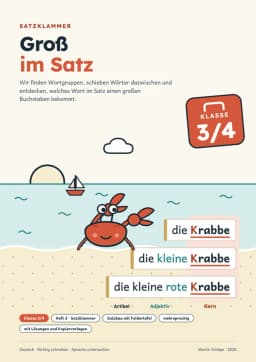
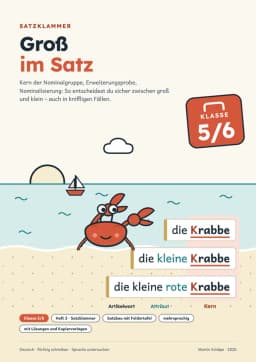
- Groß im SatzCapitalisation via the head of the noun phraseGrades 3–4 · Groß im SatzGrades 5–6 · Groß im Satz
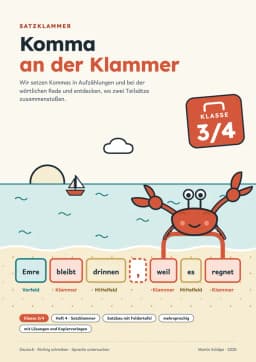
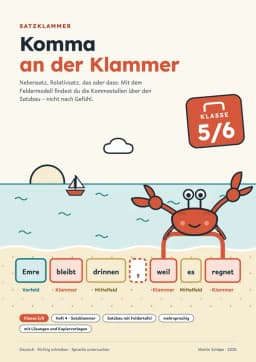
- Komma an der Klammer3–4 lists, first look at weil/dass · 5–6 subordinate clauses, das/dass, zu-infinitivesGrades 3–4 · Komma an der KlammerGrades 5–6 · Komma an der Klammer
In every workbook
- Find the bracketWhere is the verb, where is its second part?
- MoveWhat stays together when you move it?
- ExpandDoes “small” fit in front? Then it’s the head.
- Language bridgeWhere does the verb go in your language?
Workbooks and bundles
All materials are available on eduki. Here you will find contents, prices and previews.
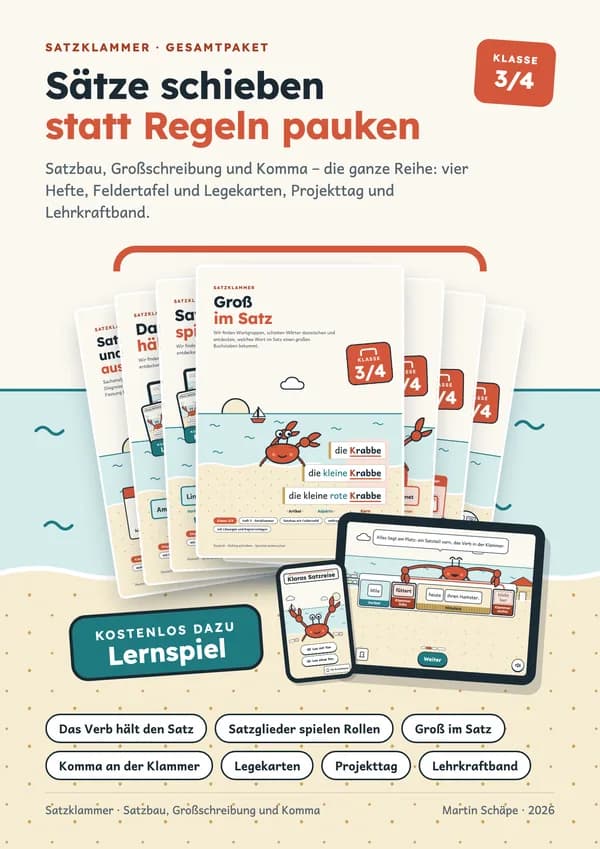
Complete bundle grades 3–4
The four workbooks for grades 3–4 from the verb bracket to the comma, the field chart and cards, the project day “Satzwerkstatt” and the teacher’s volume.
€24.99€33.93 separately
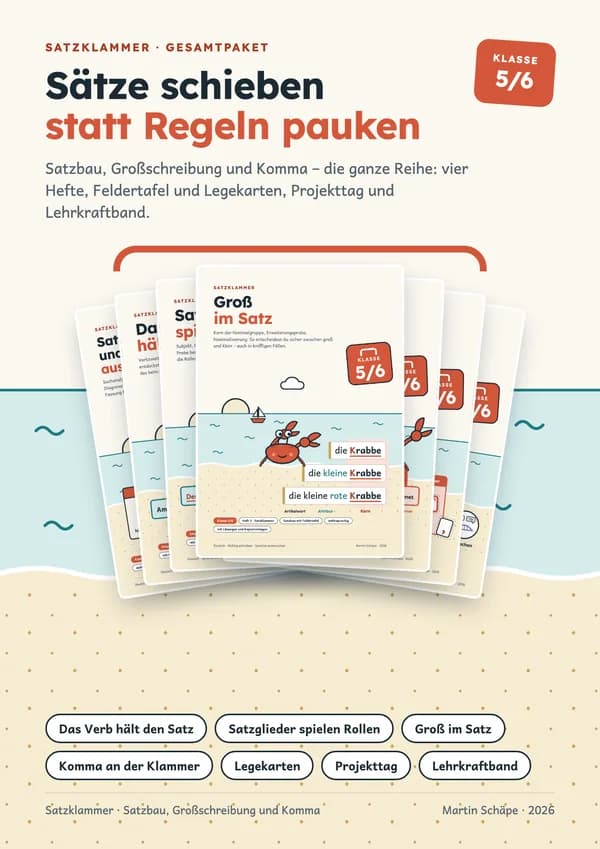
Complete bundle grades 5–6
The four workbooks for grades 5–6 from the sentence bracket to the comma, the field chart and cards, the project day “Satzwerkstatt” and the teacher’s volume.
€24.99€33.93 separately
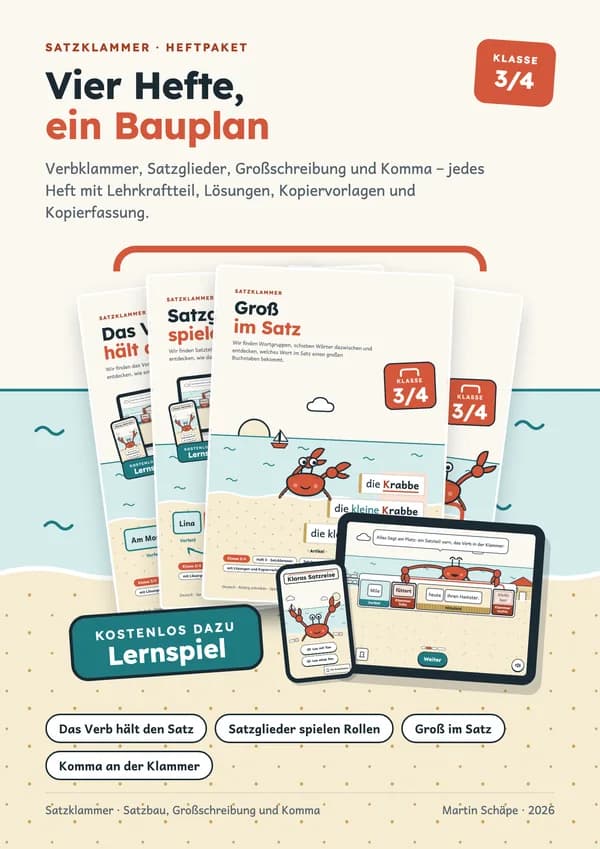
Workbook bundle grades 3–4
All four workbooks for grades 3–4, each with teacher’s section, answers, templates and a printer-friendly version.
€14.99€19.96 separately
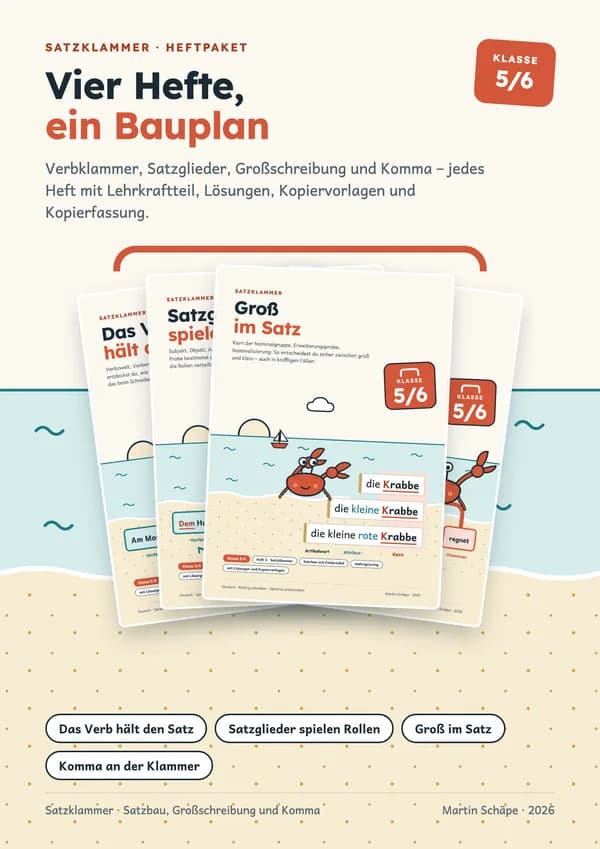
Workbook bundle grades 5–6
All four workbooks for grades 5–6, each with teacher’s section, answers, templates and a printer-friendly version.
€14.99€19.96 separately
To start with
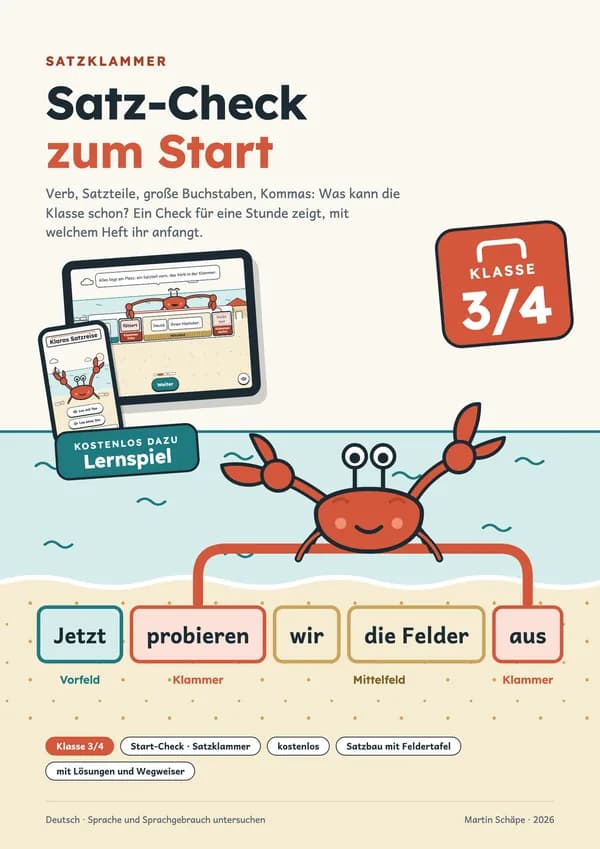
Satz-Check zum Start (sentence check)
Where is the verb? What stays together when you move it? Capital or not? Where does the comma go? Four short parts with self-assessment for one lesson; the evaluation shows which workbook the class should start with.
free11 pages · free
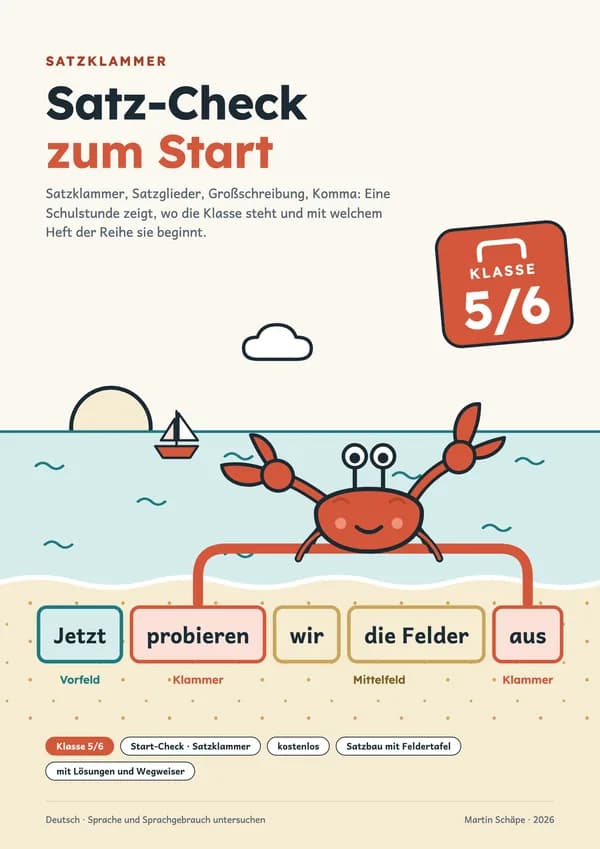
Satz-Check zum Start (sentence check)
Sentence bracket, sentence parts, capitalisation, commas: four short parts with self-assessment for one lesson. The evaluation shows which workbook the class should start with. Also works as a transition check at the start of grade 5.
free11 pages · free
Available individually
- €4.99
Workbook 1: Das Verb hält den Satz
With cards and a field chart, children discover the verb bracket: the verb in second position, its second part at the end, questions with the verb first. Plus separable verbs, the bracket test with hat/will and a myth check. With word banks, sentence starters and an answer card.
Preview: Workbook 1: Das Verb hält den Satzeduki: Workbook 1: Das Verb hält den Satz (opens in a new tab)
- €4.99
Workbook 1: Das Verb hält den Satz
The topological field model with prefield, left and right sentence bracket, middle field and postfield: identify verb-second, verb-first and verb-final clauses, make the bracket visible with the perfect-tense and modal-verb tests, and check the myth “the verb is the second word”.
Preview: Workbook 1: Das Verb hält den Satzeduki: Workbook 1: Das Verb hält den Satz (opens in a new tab)
- €4.99
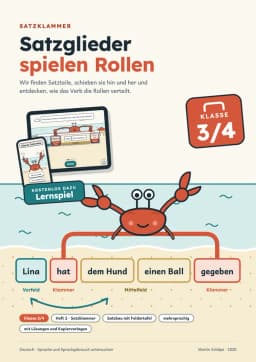
Workbook 2: Satzglieder spielen Rollen
Find sentence parts by moving them and discover that the verb hands out the roles: it decides how many players it needs. Children find the subject with the number test instead of “Wer oder was?”, and learn the forms der, den, dem with the verb’s pattern (jemand hilft jemandem). With role cards, pattern cards and a table of forms.
Preview: Workbook 2: Satzglieder spielen Rolleneduki: Workbook 2: Satzglieder spielen Rollen (opens in a new tab)
- €4.99
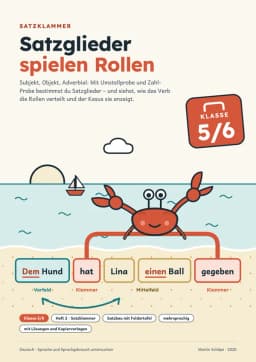
Workbook 2: Satzglieder spielen Rollen
The subject via agreement with the verb, objects and adverbials via what the verb requires, the verb assigns the roles and the case on the article often shows them (checked with the masculine test), plus the predicative and the difference between attribute and sentence part. The limits of every test are stated openly.
Preview: Workbook 2: Satzglieder spielen Rolleneduki: Workbook 2: Satzglieder spielen Rollen (opens in a new tab)
- €4.99
Workbook 3: Groß im Satz
Children expand word groups step by step (die Krabbe → die kleine Krabbe → die kleine rote Krabbe) and so find the head that is capitalised – also in die Angst, das Lachen or beim Spielen. With expansion and article tests, step cards and word banks.
Preview: Workbook 3: Groß im Satzeduki: Workbook 3: Groß im Satz (opens in a new tab)
- €4.99
Workbook 3: Groß im Satz
The head of the noun phrase is capitalised: with the expansion test the class decides on nominalised verbs and adjectives (beim schnellen Laufen, etwas Schönes), times of day and languages according to the 2024 rules – plus a proofreading strategy for their own texts.
Preview: Workbook 3: Groß im Satzeduki: Workbook 3: Groß im Satz (opens in a new tab)
- €4.99
Workbook 4: Komma an der Klammer
Commas in lists with the “and” test, and a first look at what happens after weil, dass and wenn: the verb moves to the end, and a comma separates the clauses. With sentence cards to lay out and an answer card.
Preview: Workbook 4: Komma an der Klammereduki: Workbook 4: Komma an der Klammer (opens in a new tab)
- €4.99
Workbook 4: Komma an der Klammer
Commas from sentence structure: verb-final clauses with the subordinator in the left bracket, relative clauses with the relative word in the prefield, das or dass with the moving-verb test, extended zu-infinitives under the 2024 rules. Rules of thumb are tested against their limits.
Preview: Workbook 4: Komma an der Klammereduki: Workbook 4: Komma an der Klammer (opens in a new tab)
- €3.99
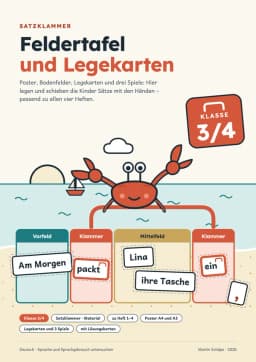
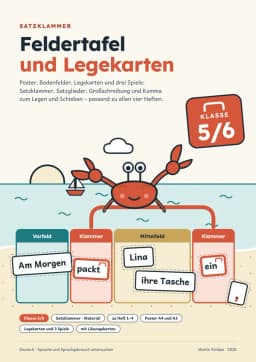
Field chart and cards
The field chart as an A4 and A3 poster, signs for taped floor fields, card sets for all four workbooks and three games with answer cards: sentence slider, role-play theatre, comma border. Goes with the series and also works on its own.
Preview: Field chart and cardseduki: Field chart and cards (opens in a new tab)
- €3.99
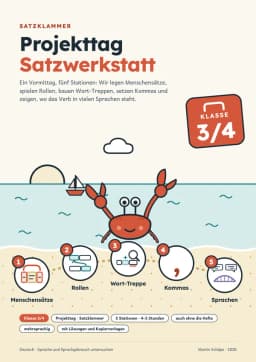
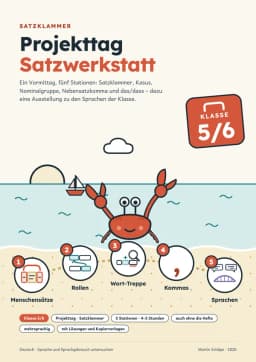
Project day “Satzwerkstatt”
One morning, five stations: human sentences in floor fields, role-play theatre, word steps, commas and an exhibition on where the verb goes in the languages of the class. With schedule and rotation plan, station cards, record sheet and certificate.
Preview: Project day “Satzwerkstatt”eduki: Project day “Satzwerkstatt” (opens in a new tab)
- €5.99
Teacher’s volume
The field model, sentence parts, capitalisation via the noun phrase and commas under the 2024 rules explained, school rules of thumb fact-checked, stumbling blocks in multilingual classes, an assessment grid for free writing, planning for both levels and a parent letter.
Preview: Teacher’s volumeeduki: Teacher’s volume (opens in a new tab)